Sunday, 22 November 2015

Mockingjay 2, a chilling ending to the series / Katniss, the ultimate Francis Lawrence's diva

I've always found The Hunger Games series very odd. Which is good. 
Perhaps is not a very known fact, but Francis Lawrence, the films' director, had his big break making the videoclip for Aerosmith's "I don't wanna miss a thing", a.k.a. "that song from Armageddon". He also made the clip from "Jaded" (one of my favorites ever, see below if you like).


Before his film debut, he worked with numerous rock and pop artists making video clips, and after taking a look at the list of clips signed by him, I realised it made perfect sense for him to bring Katniss Everdeen to the big screen.

Just to name a few and make my point, he worked with Gwen Stefani, Shakira, Avril Lavigne, Destiny's Child, Pink, Shirley Manson (Garbage), Alanis Morrisette, Beyonce, Nelly Furtado, Jennifer Lopez, Britney Spears, Janet Jackson, Lady Gaga, Mila Kunis (in Aerosmith's Jaded)...

Just a few pre-Hunger Games Mockingjays Lawrence directed

Are you catching the pattern by now?

Please see pictures above and compare poses and ideas

If you need someone to direct a video about a strong, beautiful woman with an edge, he's your guy. And the Mockingjay surely had three out of three. She's the ultimate Francis Lawrence's diva.

So, I've watched all the movies and now that the last film, Mockingjay Part 2 is out, I went to see it in the cinema, and a chilling thought cooked in my mind as the events unfolded: I've seen this somewhere, and not precisely in the books.

There will be some spoilers below, so if you haven't seen the movie and don't want to know what happens, you've been warned.


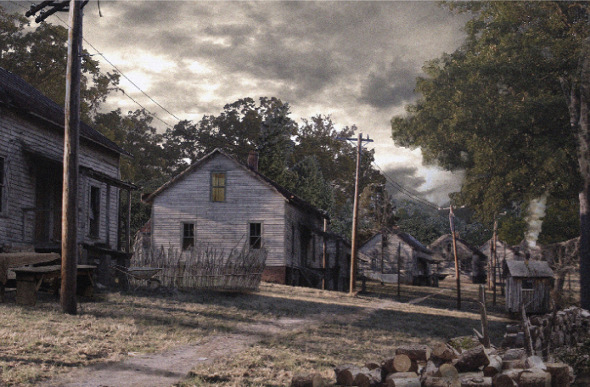
District 12, the one with the worst living conditions, the one that supplies fuel to the Capitol, has been progresively kept under tighter and more violent control. No one in the Capitol cared when 12's kids were hungry, but when the riots jeopardized the supply, the alarms went on. Eventually, corrupt and sophisticated president Snow gave the order to bomb Distric 12 and completely destroyed it. No one in the Capitol cared, everyone was watching Caesar Flickerman's talkshow, or perhaps the games.
Just another day in Distric 12. Via flightcentre.com.au
Then, the survivors fleed and reorganized in the middle of nowhere, welcomed by the blood-thirsty tyrant, president Coin who ruled District 13, an area previosly destroyed by the Capitol forces, and that now had a very heavy arsenal of weapons, a deep hate towards the Capitol and access to broadcasting.
There they, especially Katniss, are manipulated into being the face of the rebellion, making frequent and chilling videos that start spreading fear in the spoiled and desensitized Capitol population. Now they care. As the group becomes more and more radicalised, they organise to atttack the city, even willing to sacrify themselves for Coin's cause, which they've been convinced to believe is theirs.
And so they enter the Capitol and Snow decides to make an espectacle out of the hunting of the rebels.
As the city watches them on mandatory reports displayed on all screens, they go through nightmares, rivalry, internal fights, but it's too late to have second thoughts. Their faces are now on all "wanted" posters, while Coin and the game master get ready to take over in the confort of their well hidden base. It's always the young and vulnerable who take the shots for the greedy and powerful.
Propaganda loves children. Via wjlondon.com

Snow then decides to evacuate part of the Capitol, and calls up all the refugees to a safe area where food and medicine is promised. As all the scared and disoriented people follow his instruction, Katniss and her "star squad" infiltrate the refugees and, hiden amongst them, plan to get close enough for an attack. 
Surveillance is weak and they manage to seize the chaos to get to Snow, and then, when he's captured, Coin makes her move and brings fire to the Capitol. Now the bombs weren't in distant and empoverished Distric 12, they were in the heart of the shinniest city of Panem. The children crying were not malnourished, the adults running were not miners and farmers, and the buildings burning were not shabby huts and improvised markets.

Then a Real Life makeup brand started selling 12-Districts inspired makeup. Via ecocult.com

And at that point, Coin shows her (ill-hidden) true colours. After what could pass as a successful coup d'etat, she seats in Snow's office with her military junta and appoints herself "Interim" President of Panem, with elections coming, eventually "when the time is right". 
Then, her first motion is to organize a "symbolic Hunger Games" where the districts will get their awaited revenge by watching the Capitol's children fight each other in the arena. As a populist, vindictive, master of propaganda, the woman knew who'd be the sole winner of that.
Katniss, who had knew for a while that Coin's medicine was worst than Snow's disease, manages to put her down before she pull off that plan, and a mob of angry people takes care of Snow. After that, in an idealistic turn of events, Panem actually gets what seems to be a fair election and a decent president, so everyone can now go on with their lives and rebuild their homes.
But the nightmares will never go away. And the lost ones will never come back.

Francis Lawrence was also aware of the uncanny resemblance of the movies' story to less fictional events, and in an interview he gave after the premier of Mockingjay 1, he resumes it very accurately: "Suzanne Collins wrote a series of books specifically about the consequences of war, and one of the facets we get to explore in this movie is the use of propaganda in war, and the manipulation of imagery and people in the use of propaganda. Unfortunately, this kind of thing has been happening for a really long time. Now, due to technology, it reaches people in a faster, more immediate way.”

The Carrot Vs The Stick

Perhaps, if there was a Hunger Games' expanded universe, we could have seen more of the other districts and more of the Capitol. Probably we've seen the better-off districts worrying slowly and becoming paranoic when the fire arrived. Maybe, we'd discovered that many people with Capitol's passports were recruited and radicalised thanks to the Mockingjay's charisma and manipulation (see flamboyant Effie, who turned up to be a rebel). Who knows, if there was anything similar to social media in Panem, many people would have covered their profile picture with the Capitol's colours to show empathy, while others would bitterly wonder why wasn't it possible to get District 12's colours when it happened there.

I think that Mockingjay Part 2 was a pretty good movie, with an eerily timed premiere, and even though it was slower and longer than The Hunger Games and Catching Fire, it was fair to the books.
And by the way, Francis Lawrence -the director- and Jennifer Lawrence -the Star- have the same last name but are not related. Speaking of coincidences.

Saturday, 14 November 2015

What about a diet, but instead of changing what you eat, you'd change what you read/watch/listen?

There are thousands of diets out there, and lately I've been thinking... if we can adjust the way we eat in order to obtain a certain result, maybe there is a similar way to change what we consume as entertainment in order to think differently.

I started to think that after realizing how much time I was spending online doing nothing, learning nothing and not even having a real laugh. I started to feel like those people that notice they're getting sick because they eat fast food and ready meals all the time. Yes, they're cheap and tasty, but deep down you know they're not the best you could be having.


And there's nothing wrong with indulging in a never ending scrolling of memes and social media statuses, nor will I judge anyone who's spends a whole evening reading one Buzzfeed list after the other (those 84 thoughts they had while watching Game of Thrones really are all of us) or someone that follows more "and you won't believe what happened next" links than they would like to admit.
However, when it came to the point that I was giving it almost enough time for it to be a part time job, I felt that I was starting to think in GIF images and memes, and I didn't like it.


It got so bad that just as older people might have a saying or a popular expression for many things, I caught myself repeating popular captions such as "nothing to do here", "I'm not even mad, that's amazing" and "I'm not always X, but when I do, I Y".

Let's say that if I were to compare entertainment/information to food, I would be exchanging most of the fast food, takeaway and ready meals I was having daily, for a mix of homemade cooking, some quirky artisan products and a good sandwich from a nice deli. It doesn't sound so drastic because it isn't, but I'm not ready to go vegan on my enterteainment either.

Instead of setting it by the day, as you can more easily do with food because you eat it three times a day, here's an example of what I'm trying to get done in a week:

1. Watch 1 "good" blockbuster movie: Everyone will have their definition of what a "good movie" is, but to keep it simple for the example, let's say it's a movie with at least decent ratings both from critics and audience in the website Rotten Tomatoes (although if it has a great score on one side and awful in the other it might be interesting as well). Ideally in the cinema, by the way.

2. Watch 1 "good" non-blockbuster movie or a few episodes of a good TV series: It can be a classic, a documentary, a "foreign" (non Hollywood), an independent or a lower budget film. In other words, something that is a bit different. 

3. Read/listen to the news for a few minutes every day: One of the things I love about living in a country in which occasionally you get good news is to find out about them. I leave them on, on the radio on my way to work, or stop and read an article or two when I see them shared in my social media.

4. Catch up on social media, and then move on: Instead of jumping to my screen everytime I hear the alarm, I will tend to it when I have a moment to dedicate to that, and instead of compulsively checking every post from every friend, I'll just do a quick scroll and stop if I find something interesting or truly funny.

5. Not sharing rubbish: I wasn't very guilty of this anyway, but now I try to do it even less. Well, maybe a picture of a dog occasionally is not the end of the world, but you get the idea.

6. Not engaging in Internet arguments: I used to do it sometimes, out of boredom or to defend  a friend, but it's just not worth the time.


7. Read a few chapters from a real book: By real I mean a paper book, just because I like it, but an e-book is fine if that's your thing. But it has to be non technical please, recipe books and manuals don't count, and neither do magazines, even though some of them are great. Fiction, non fiction or something in between, try to go through a couple dozen pages at least, before you put it down.

8. Make something creative: Maybe write a short story or at least a page in my diary or a post in here, attemp to mix some music samples (I've tried once so far so it counts!). If I'm feeling dumb, at the very very least, fill up half a page from a colouring book. 

9. Listen to new music: I love my playlists, but sometimes when you play the same few songs over and over, you might not discover something new you will love. Spotify is great for this, but many pages and apps can help. And it doesn't have to be literally "new" it can be a very old band, or a new album from a group you used to listen to. As long as it's NEW FOR YOU, then it counts.

10. Have more conversations: In person, via Whatsapp, Skype or Facebook... it doesn't matter, just ask some one how they are or what are they thinking, and listen/read, and then talk/write. It's as simple as that.


I don't know if I'll have time to get all these done every week, but I'm sure I'll try. 

Sometimes I crave to see a hundred memes or funny vines, and sometimes I do, but not all the time anymore. I won't pretend to recommend anyone anything or tell prople what to do, but for me, so far, so good.

Friday, 6 November 2015

Three questions you should ask yourself before bullying your staff or coworkers

I'm so fed up with the sadistic culture going on in many kitchens, where you are expected to be humilliated before they teach you anything. It's just like a cycle of domestic violence where the child that was abused grows up, and now he hits his wife and children.

I've seen it so often. I know many wonderful people working in the food industry that sometimes suffer because a bully at work makes their life miserable and they are afraid to speak up or confront them. After all, the fear of losing your job is real and strong.

So, when you want to abuse your staff or coworkers, please ask yourself the following three questions:

1. "Am I building a pyramid?": If the answer is NO (which it is), then have some self control and avoid acting like if you were raised by wolves in a mental asylum.

Nothing against wolves, they're actually excellent at team work


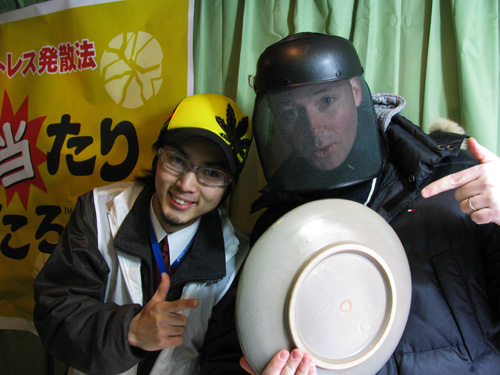
2. "Is this my way to get revenge at this unfair world?": If you can relate to that statement, please change your approach. There are places in Japan where you can pay to be allowed to break dishes. You can also join your local fight club or find a moshpit and let the rage flow between consensual adults, perhaps you can even make friends with a masochist.
Via mikesblender.com


3. Am I the last living master of a mythical martial art?: If you are, then I give you a green light to go and get a hut at the top of a mountain and make your aprentices suffer in order to gain your ancestral knowledge. If you are not, please stop acting like you were.


Thursday, 29 October 2015

London was a slap of fresh air in my face

A couple of weeks ago I travelled to London for the first time. You always read the name next to New York, Paris, Tokyo and other super capitals of the world. You see it in movies: tourists trying to make a Royal guard laugh (no touching), everyone walking fast under their umbrellas in the rain, and the Big Ben overseeing all the madness.

Imagine the possibilities of randomly running into a friend 

I've realized by now that I am a small city person, I get bored in villages and stressed in metropoles, so for me, Dublin is what the warm oatmeal plate is for Goldilocks, but meeting a new place is always exciting.
So I arrived, alone and for five days, having the privilege of staying with great people I haven't seen in a very long time and that happened to be living in London.

I have to admmit that for the first half of my trip I was overwhelmed. The distances too long, the prices too high, the crows too big, and I've never been a skilled map reader so, being without Wi-Fi most of the time and using an old school paper map to get by was a challenge.

I assure you, it was more colourful in real life

The people were surprisingly kind, except if you were standing in the left side of an escalator, and everywhere I went there were the same three or four food-on-the-go chains. Yes, there were good restaurants, but I was on a budget and actualy on-the-go, as I wanted to see and do as much as possible, so for the duration of my trip, I sticked with a diet of sandwiches and prepacked sushi.
A course I was taking absorbed most of my time, but I was able to see the London National Gallery and Tate Modern. I'm not an art expert, but I enjoy visiting art museums and staring at pieces that catch my eye, trying to identify what's it about them that atracts me. I've also went to the beautiful St. Paul's Cathedral, to Hyde Park (were I had the chance to share my on-the-go avocado wholegrain sourdough toastie with a squirrel) and to Spitafield Market. 


Just sharing with the locals...


Spitafield Market

National Gallery [In the back] 

In that last place I made the only shopping I allowed myself to do in the city: a hand painted shirt with a little cottage lost in a forest of pines. I had to have it. Near that, I also visited the famous Cereal Killer Cafe, a place that only serves bowls of cereals (but they have tons of options).
Of course I went to a pub and had a pint with the classmates. A very drunk local guy approach the table and he was allowed to stay and make a fool of himself by talking a bit of nonsense and attempting to stand and dance on his chair.

I'd say one of the most "travelly" things I did was visiting The Monument, a 62 mts tall structure which happens to be the tallest isolated stone column in the world (thanks Wikipedia). 

The Monument


I say "travelly" because it was really out of my comfort zone, in fact, I don't know what got into me -I'm a person that is scared of heights and gets vertigo in shopping centre's balconys- but I was walking by it and decided that I wanted to see London from the top (who doesn't?). I paid my 4 pounds ticket and started going up the winding stair, looking out from the small and frequent windows that reminded me that every step up I took, I was on a deadlier distance to the ground.

I just kept looking to the centre of the spiral

Thoughts of the thing falling apart with me inside it, of a person running and bumping into me accidentally (or on purpose) pushing me to the floor, tempted me to stop and go back. And it wasn't just because it cost me 4 pounds that I kept going... when would I get another chance to do that? The fact that I could hear children laughing on the top only made my fear seem more irrational and silly.

So I decided to stop overthinking things and then, London and I got along better... I rolled my eyes to people standing on the left side of the scalators, found my way around without asking and for a moment, I got why people love living in very big cities where everything happens at the same time, where you are anonimously free yet constantly tracked, and where trends come and go faster than you can even find out about them.

London is beautiful and exciting, fun and scary, punctual and messy, friendly and hostile, and just like the mushroom in Alice in Wonderland, it can make you feel big or small depending on which side you choose. 
I went back home with a cute shirt, a souvenir from the museum, a pinecone from Hyde Park, a bunch of overpriced subway tickets, and the slap of fresh air I badly needed.

Wednesday, 7 October 2015

The 10 types of Venezuelans you'll find abroad (at their best and at their worst)

"Life was like a box of chocolates. You never know what you're gonna get." Wise words by Forest Gump's momma. Well, this applies to many things, including of course, meeting people, and in this particular case, meeting Venezuelans abroad.
We might be all chocolates from the same box, but we surely come in very different flavours.
So after thinking about writing this list for a few days, I decided to compile 10 cliches I've noticed when meeting Venezuelans in foreign lands.


"Did you read about what happened yesterday in the Asamblea?" 
1. The one that never left: Yes, his passport has the stamp, his body is in front of you, but his mind is miles away, somewhere around 10°30′N 66°58′W (I've always wanted to quote coordinates on a post!). They obssess about the currency exchange rate and read Venezuelan news constantly, but are unable to mention a current event in the city they sleep in. They belong to dozens of whassapp groups, and spend more hours in social media than socializing IRL.
At their best: They somehow managed to keep in touch with friends and family and found a way to be there for them despite the distance. 
At their worst: They don't enjoy their new surroundings, and are always in their own little bubble.


The sad thing is that they don't exagerate, sometimes they even tone it down (Via visual.ly)
2. The sensationalist: Did they tell you about Caracas being in the world's top 5 cities with more murders per capita? They won't shut up about Venezuela's darkest facts (yes, sadly, facts). Corruption, kidnapping, extorsion, riots, shortages... that time when he witnessed a person getting mugged at gunpoint (or when his car got stolen) is his favorite cocktail ice breaker. This person seems to take a secret and sick pleasure in sharing these tales, almost like if letting you know what they've seen would give them some sort of street cred mixed with victim status. 
At their best: They help to create awareness about all the mess that's going on back in the country.
At their worst: They are downright depresing. 


Hi there, allow me to recommend you some place for coffee (Via reddit.com)
3. The camouflaged one: They look like a local, walk like a local, eat, talk, dress and party like a local so well that they blend in in their new environment completetly. Or so they think. The Japanese have an expression for these people, they call them "Henna Gaijin" which ironically means "strange foreigneer": non-Japanese people who act too Japanese-like. 
Funny thing, in Ireland there's an expression: "more Irish than the Irish themselves", which makes reference to the cultural asimilation that foreigneers experience in the island (the Irish lifestyle is hard to resist, with the exception perhaps of crisps sandwiches).
At their best: Turns out they are legit, they adapted and are true locals to their new community. 
At their worst: They are faux locals trying too hard. They come up as pretentious and artificial.


A fine example of this type, Edgar Ramirez (centre) Via ladepeche.fr
4. The overachiever: Whether they are directing orchestras, discovering the cure for some disease, winning gold medals or helping launch rockets into space, these Venezuelans are celebrated. They are shinning abroad, putting their PhDs and creativity to good use in a country that has given them the opportunity they never had at home.
At their best: They are role models that make us proud and show us that the great ones weren't all born in the XIX century.
At their worst: Run away from the ones whose success is seasoned with arrogance, especially if they are good with social media.


Dmitri: Here I am janitor. In former Soviet Union, I am physicist; Leningrad Polytechnica - Go Polar Bears. Via bigbangtheory.wikia.com
5. The overqualified kitchen porter: A degree from a top university, postgraduate studies and fluency in three languages. This one should be mingling with the academic elite or wolfing their way to the top in a corporate environment right? But then, something happened, and they never found that golden job yet they still needed to pay rent. 
There is an episode in The Big Bang Theory, where the guys participate in a physics knowledge competition and, missing one in the team, they recruit Dimitri, the Russian janitor. Turns out the guy was a physicist in the Soviet Union and he knew the answer to a question not even Sheldon got right. Well, they point is, this one is our Dimitri.
At their best: They are educated, resilient and hard working, with a rich inner life, aware that their jobs don't define who they are.
At their worst: They are bitter, jaded and jelous of everyone whose job doesn't involve a sink.
6. The leech: If life was actually a box of chocolates, they would be the one filled with a pink chewy cream that tastes horrible. They're our rotten apples, the bullet on a game of Russian roulette, the rabid dog that bite the hand that feeds. They're the reason why we don't trust each other. They're the ones that steal from the till at work, that will take your bike, that run shady businesses and scams. They are the ones that will do anything to get rich, except working.
At their best: Can't find anything good about them... perhaps that they force you to be extra nice, to compensate for their parasitic ways.
At their worst: They give us all a bad name, and make life harder for the ones trying to do things right.


It's a beautiful day for a wedding (Via allthingsburton.tumblr.com)
7. The impoverished sifrino: In case you don't know, a "sifrino" (see-free-noh) is a posh guy (sifrina, a posh girl) that lives a priviledge life, often criticized for being clueless and caring little for others. They might not have the best education, but they probably went to the most expensive college (and partied their way to a completely unpractical degree). Now, in a new country, far from mom and dad (this made worse by the fact that it's nearly impossible to legally send money abroad from Venezuela) they're a bit like those aristocrats that ran out of money but try to keep the illusion of being rich for as long as possible. 
At their best: They become humbler, kinder and nicer, and they grow as a person from their experience.
At their worst: They are horrible at managing their money and if they don't find a good salary soon or change their ways, they'll end up reluctantly going back home or becoming leeches.


Via ibc.org.br
8. Everyone's friend: They are the life of the party. Warm, happy, optimistic and charismatic (very often they are seriously good looking as well). These guys and girls will cook arepas for you, teach you how to dance salsa, and tell you all about the beautiful beaches, mountains and landscapes of Venezuela. They might even share with you a fancy bottle of rum that they brought for a special occasion. They are always smiling and they always give you a little kiss on the cheek when they greet you.
At their best: They are great fun, their friendship is real and they will be there for you no matter what. 
At their worst: Turns out they are too nice for their own good. They get scamed easily (sometimes by a shameless leech) and can move to the dark side if they hang out with bad influences.


"I'm ready for a pint" Via hotelfotosdelpersonal.blogspot.ie
9. The identity overcompensator: When they were living in Venezuela, they used to listen brit pop, eat sushi as often as possible and dress like a character from an American sitcom. And suddenly, they're far and they develop this absurd nostalgia about traditions they never participated in, food they never cooked, sports teams they never rooted for and beautiful landscapes they never visited. They wave flags like they never did before, pay ridiculous prices for smuggled Venezuelan candy and slowly become a theme-park version of Venezuelaness.
At their best: They don't harm anyone and they get to show people a thing or two about Venezuelan culture.
At their worst: You can't help but feel they're faking it. Nobody likes malta THAT much.


10. The one that reminds you of yourself: Here you were, thinking that you were the only sane person holding a Venezuelan passport and then you meet each other. You both are kind, normal people, with flaws and dreams, working hard to make it in another country. You both kept some traditions and adopted a few new ones. You make plans to spend Christmas together and go to each other's birthday. You don't speak Spanish unless everyone in the room does too (but sometimes a comment or joke here and there finds its way) and you slowly gained each other's trust.
At their best: You become very good friends, you understand each other and support each other. 
At their worst: You get competitive and mess things up. You play in the same league, but what could have been teamwork, becomes rivalry. Such a waste.

I can say I've meet at least one of each.

I can also say that I've been a little bit like all of these types.

Except for the leech. Feck leeches.

Wednesday, 30 September 2015

10 ingredients wildly popular in Ireland that are originally from Latin America

I'm on a streak of writing about food and after listing my newly acquired Irish eating habits, and letting you know about some relatively unkown facts about Venezuelan food, I started to think about the many ingredients that we share and I realized that there are lots of Latin American ingredients that are iconic in Irish food.
Some of them are probably no surprise, but you'll see a few unexpected apperances...

Via two-views.com
1. Tomatoes: A must-have of the irish breakfast, this fruit (yes fruit) was once thought to be poisonous. Grown first in Central America and western South America, it was already in the Aztecs' diet around 500 BC. It arrived to Europe around the XVI century and slowly grew on the local palates. 
The Irish way: As mentioned, rosted in the Irhish breakfast, but also in salads (everyone seems to love the cherry tomatoes) and rolls. 


2. Turkey: This bird, native to forest of the north of Mexico and the United States is one of the most popular poultry options (I'd say the second best seller, after chicken) and also, one of the most awkwardly named creatures you can eat: Europeans who discovered tought it was some sort of guineafowl, which they usually got from Turkey (the country). Then they started calling it "Turkey fowl" and then just "Turkey". By the way, in Turkey (the country), this bird is called "Indian" (perhaps in relation to its original French name coq d'Inde or rooster of India, which makes sense as Europeans kind of though America was India when they first arrived), and Indians (the people) call Turkey (the bird) "Peru". In Peru (the country), the bird is called "Pavo".
The Irish way: The ultimate diet meat, as it's lean and has lower calories than other meats. Have it in wraps and multigrain sambos, or go classic, and serve it Thanksgiving-style (more American than Irish but relatively popular here anyway) with stuffing and cranberry sauce.
Serve it differently: 


Via livepuntamita.com
3. Cocoa: Despite popular belief, cocoa -which as you know is the main ingredient of chocolate- wasn't originated in Mexico (although you have to give it to the Aztecs, they were the ones that made it a big deal for the first time), but in the Amazon region in South America (Venezuela, Colombia, Brazil). It made its way to what's now Mexico and then Spanish conquistadors took it back home where, unlike the tangy and bushy tomato, it became an instant hit.
The Irish way: The Irish are obsessed with chocolate. Every occasion has its own shape to eat it: Valentines's Day (red heart shaped), then Easter (egg shaped), then Mothers' Day (pink heart shaped), Halloween (spooky themes shaped) and of course, Christmas (rose shaped for some reason). Besides that, it's used for all types of sweets and confectionery such as chocolate digestive biscuits, rocky roads, brownies, etc.


Via blogs.disney.com
4. Corn: a.k.a. Maize, this grain was domesticated in Mesoamerica during prehistoric times, it is kown to have been eaten at least 7000 ago in Mexico. It was so important that it became part of people's identity in many Mesoamerican cultures. The Mayans even believed that they were literally made from corn.
The Irish way: Almost exclusively two varieties: sweetcorn and popcorn. It is enjoyed mixed with tuna (really?) and in sandwiches and rolls (no self-respecting deli is complete without this ingredient). The popcorn type is commonly eaten not just in the movies, but as a prepacked snack in several flavours (lovely!), seen as a lighter alternative to chips.

Which takes me to...

Via fromchinavillage.com
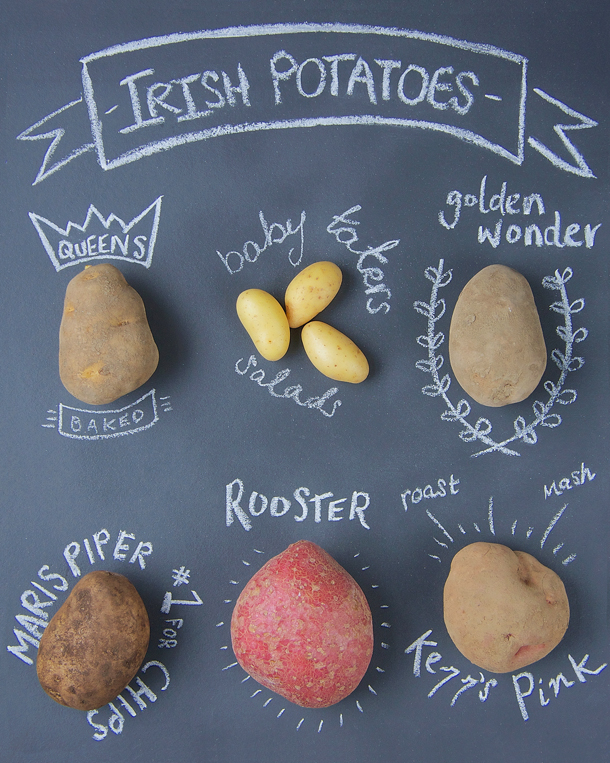
5. Potatoes: I can't imagine Irish food without the potato. Which makes it easy to imagine it has a legendary Celtic origin or that ancient tribes harvested it and discovered its many uses. But in reality, the spud is Peruvian (and from the north of Bolivia) and it was cultivated at least 2.500 years ago (some say 10.000) by native peoples. It arrived to Europe through Spain in the XVI century and a few decades after it was growing in Ireland.
Its lower spoilage rate compared to other foods, its cheapness and its filling quality made it one of the main produces in the island. With millions of people eventually becoming dependent on the potato for food, and due to economic and socio-political circunstances unable to feed from anything else, the mid XIX century potato blight was devastating in the country.
More than a hundred years have passed and even though it will never be forgotten, things have change, happily for the best. And even though today, you can find food from all over the world in Ireland, the simple potato is still the most popular ingredient around.
The Irish way: Crisps, chips, smashed, baked, roasted, stuffed, in wedges, just the skins with bacon and cheese... (I'm starting to feel like Bubba from Forest Gump when he talks about shrimps)... It's only a matter of time to have potato ice cream and smoothies.


Via cavesbranch.com
6. Vanilla: You hear things like "French Vanilla", "Madagascar Vanilla" and "Tahitian Vanilla", so you might think that it's original from some of these places. But nop. It's Mexican, and its name means "small pod" ("vaina" is Spanish for "pod"). By the way, normally you see it as an extract or with luck, as thin black sticks, but it comes from an orchid (V. Planifolia). By now you won't be surprised if I tell you it was cultivated by the Aztecs and briught to Europe by the Spanish, but it might shock you that the majority of the vanilla-things you eat are actually flavour with artificial substitutes, as real vanilla is the third most expensive spice in the world (topped by cardamom and saffron). So if you want the real vanilla, check your ingredient list carefully and be prepared to pay.
The Irish way: A touch of vanilla syrup in coffee, or as flavour in custards, ice creams and sweet creams... Prety much the standard global way to use vanilla, though.


Via wileynutritionbytes.com
7. Peanuts: The most popular nut in the world, which is actually a legume, was domesticated and cultivated first in North Western Argentina (some say Bolivia, proably both as there were no borders in prehistory but that is not of my business). 
The Irish way: Peanuth butter bonanza! Smooth, crunchy, organic, with chocolate... in here, people literally buy it in buckets for home consumprtion (well, not everyone, but I see them in shops not meant for wholesaling so). Also salted or cevered in flavours.


Via seriouseats.com
8. Pecans: These tasty nuts come from the North of Mexico and the South of the United States. Both countries are still the biggest producers nowadays.
The Irish way: You'll find it on plenty of confectionery (commonly mixed with maple syrup) and salads. Sometimes if you're fancy, with turkey (the bird) or chicken.


The next two are not as traditionally popular in Ireland, but they are very trendy, widely available and I decided to include them in the list because they are tasty, healty and becoming bigger as I write.


Via cupofjo.com
8. Avocados: With the scientific name of Persea americana, it is clear that this green fruit (yup, just like the tomato, so basically guacamole = fruit salad) comes from the "new world", more especifically, from East-Central Mexico. Oldest evidence of avocados in the area are up to 10.000 years old.
The Irish way: Try to find a brunch menu in Dublin without Avocado on Toast, come on, I dare you. Besides that, lots of burrito places have it as guacamole, and some healthy delis offer it as well. It's becoming more and more popular by the day.


Via alterecofoods.com
10 Quinoa: This grain that is actually a pseudo-cereal (what's with this deceiving food pretending to be vegetables and nuts and grains?) which originated in the Andean region (Peru, Bolivia, Ecuador and Colombia). Depending on who you ask, it's been known between 3.000 and 7.000 years ago. Since it's filled with most nutrients than other grains (or psuedo-grains), and it's very versatile (kind of like couscous), it is becoming a very popular ingredient, especially for the health and nutrition oriented foodies.
The Irish way: Find it at an absurdly expensive price in health shops and healthy restaurants. Commonly served in salads.

Again, some of them come as no surprise, but I find really cool that lots of Latin American ingredients have become part of the Irish diet and tradition, some recently, some centuries ago. 
And they are all so tasty and good for you! Yummy :D

Friday, 25 September 2015

5 eating habits I've picked up in Ireland (and 5 that aren't going to happen)

When in Rome do as the Romans do. 
That centuries old phrase never gets old and it's been one of my mottos since moving to Ireland. Not just because I feel that integrating to the local life is important, but because I've found that what Romans do here is usually great fun.

Via rte.ie

On this occasion, I'll focus on food and drink, and I'll share five habits that I didn't have in Venezuela and that are part of my everyday now, and five that I can't just get.

So, let's start with the adopted ones:

1. Ordering take away: I used to think that take away was just for pizza, and if I wanted to get chinese food, sushi or whatever, it was a waste of occasion to eat it home, as I like the idea of dressing up and going to a place, eating in and not having to clean up or worry about anything. However, that amount of places here especialized in take away foods (with no tables, just a counter), made me change my mind. Besides, on colder days, you still want to eat something different (by that I mean cooked by somebody else), but you're already in PJ mood.

2. Go to the pub: In Venezuela, most people that go out for drinks do so in places with loud music and dance floors. The idea of a place where you just sit and have a pint is relatively unusual (perhaps recently a few places are introducing it but if there is no loudness and dancing, the mainstream public is not really in). And yes, there are bars in Venezuela but either they are the 5 Star Hotel ultra fancy/expensive ones, or the shady ones where things can end up Dothraki wedding style. Not my thing. Is it too much to ask for a nice, clean place where you can sit and have a chat with friends over a couple of beers, with some decent food and feel safe? Not in Dublin, where there are hundreds of places like that. Nice.

Via glenmcclure.com

3. Online grocery shopping: Best thing ever. Don't get me wrong, I love grocery shopping, but in the last few years before moving, shopping in Venezuelan supermarkets became sad and scary (shortages, military control, absurdly long queues, etc). This still breaks my heart, but back to topic: the fact that I can get all the food I want with minimal effort is amazing, and even if I go in person from time to time, if I'm having a very busy week, I just buy my food online and it's here the next day. 

4. Having darker beers and/or craft beers: In Venezuela, we drink mostly lagers and it's ok. Under the tropical sun at 30 degrees you wouldn't feel like ordering the back stuff anyway. But here, the amount of options made me realize that these light golden beers are not really the ones I like the most. Now I usually get a red ale or pale ale. Cheers!.

5. Eating ice cream in the winter: The first time someone sugested we get gelato while walking on Grafton Street during a cold winter day I was puzzled. I thought they were joking. But you know what, who cares, there's heating everywhere and it's a great treat to hold while Christmas window shopping (did I mention that Christmas here starts in early September? Which I LOVE).

Runners up: Sandwich for lunch, eating scones, going to discount supermarkets, eating cheddar cheese, boil in the bag rice, using teapots.


But I won't lie, not everything has been so catchy for me, and there are a few things that I still find odd, or just plain unpleasant.

1. Having chips or chicken with pizza: chips with pizza? really? Besides it being a carbs overdose, just doesn't make any sense. Nor I understand the point of adding chicken as a topping to pizza. For me, it ruins it. Sorry not sorry.

Via glutenfreeadventuresandme.co.uk
2. Ordering fried chicken in an "Italian" takeaway: The one thing that I just don't get about takeaways (which as I stated in the first part of the post, I love) is how so many places advertise as "Italian" and they are actually a mix of pizza, kebabs, chinese and fish and chips. Mamma mia, WTF! I used to look for risotto or lasagna on their menus unkowingly of the situation, but now I see that if I want real Italian food, I better go out or make it myself.

3. Drinking energy drinks and sports drinks without doing sports: I see them in the bus, in shops on the streets... Seems like everyone likes to drink these drinks instead of plain water. Now that I think about it, I don't see many people drinking just plain water. I don't like energy drinks, and I just don't see myself adapting this habit.

4. Breakfast rolls: This bomb ussually include the ingredients of a traditional Irish breakfast (which is awesome), but all squeezed together in a half baguette (which is just too much). I'm not a vegetarian, but there is something about a roll filled with rashers, black pudding, bacon, sausage and butter that doesn't feel right to me.

5. Brunch at 2pm: Brunch is a word that combines "breakfast" and "lunch", so logic would dictate that is done between those hours (I like it around 10 or 11 am). But noooooooo, not in here. Not even the restaurants are ready for brunch in the morning (most open at noon). So if you have it at lunch time, then why is it called brunch? Is just lunch. Just luch. Really. 

Runners up: crisps sandwiches, tomato soup, rocky roads (and many candy-covered traybakes), 

Are there any eating habits you've adopted after moving to a new country?